phaseffect
How much does the menstrual phase move wearable metrics and symptoms, and does a person’s own shift repeat?
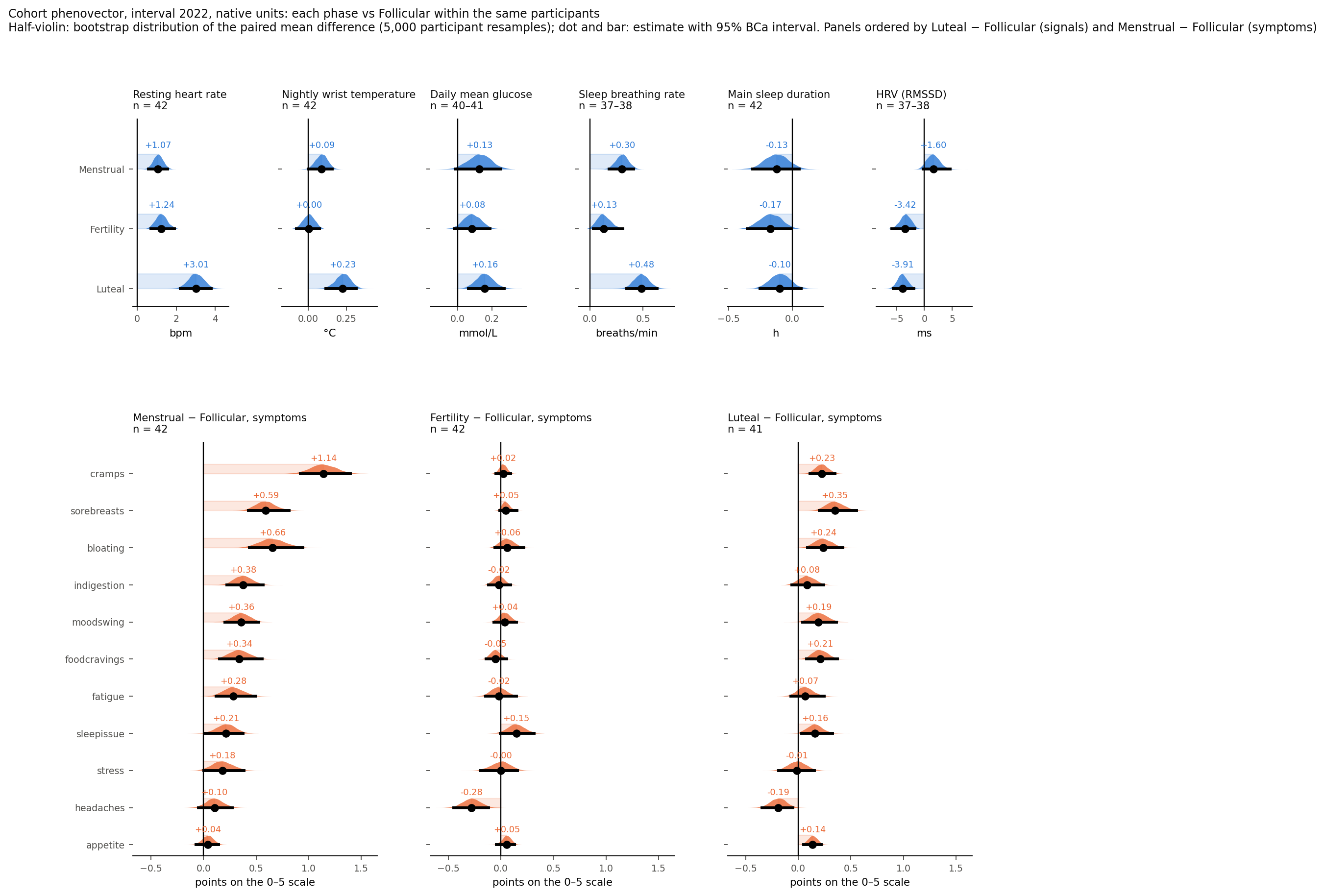
Interval 2022 of the mcPHASES dataset: 42 participants, Fitbit Sense, Dexcom CGM, Mira urine hormones and a daily diary over about three months. Phases come from the hormone-based labels. Every contrast is within the same participants, against their own follicular days, and is reported as an effect size with a 95 % interval. Nothing on this site is participant-level.
Cohort shifts by phase
Luteal − follicular, same participants: resting heart rate +3.0 bpm [2.2, 3.8], wrist temperature +0.23 °C [0.12, 0.31], glucose +0.16 mmol/L [0.06, 0.27], breathing rate +0.48 /min, HRV −3.9 ms. Menses is the symptom phase: cramps +1.1 points, 41 of 42 participants higher.
Does a person’s shift persist?
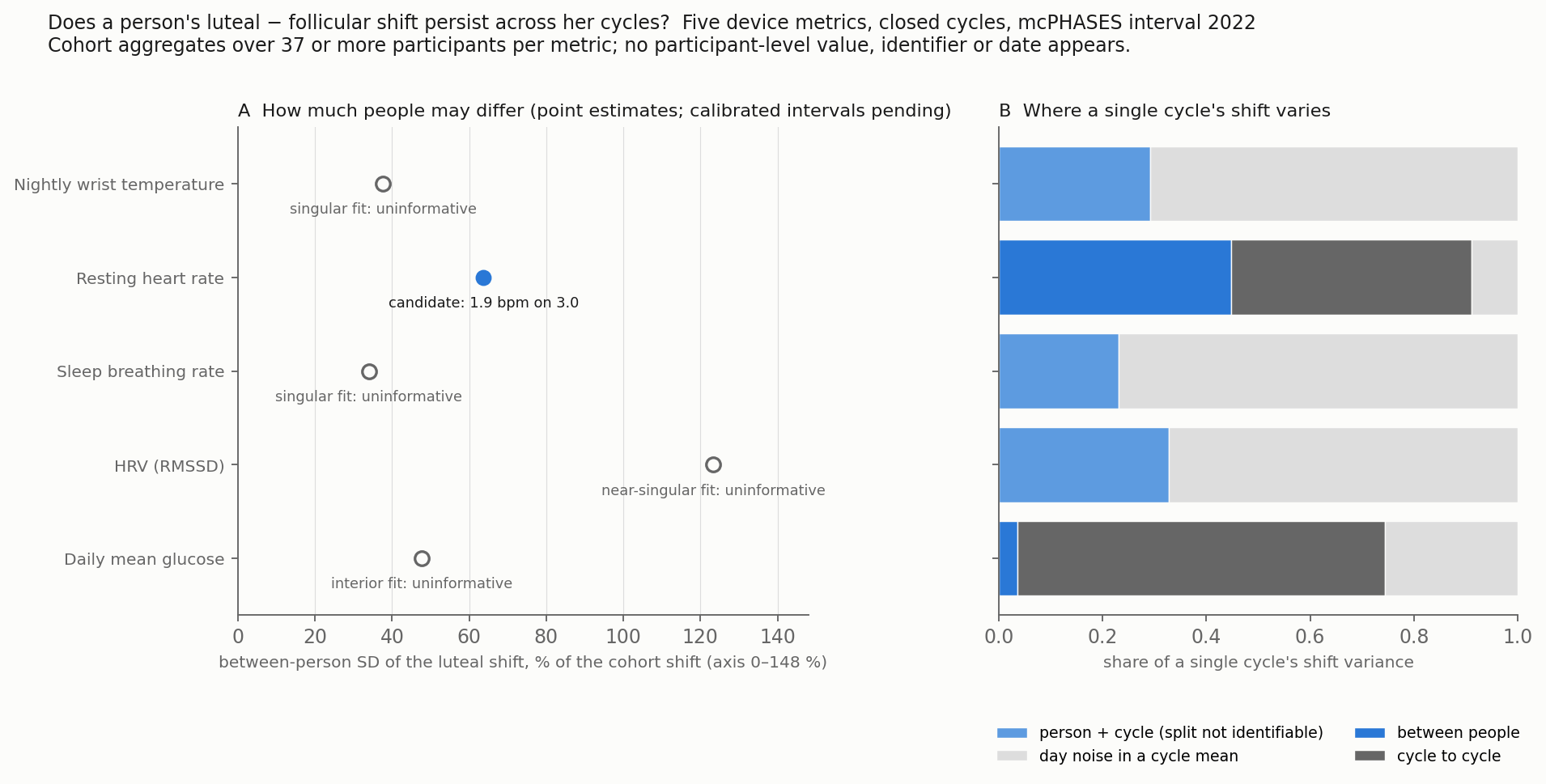
The average contrast is clear; whether people differ persistently in it is not settled. Resting heart rate is a candidate: a between-person SD of 1.9 bpm on a 3.0 bpm average, larger than most simulated no-difference cohorts produce. The other four metrics are uninformative. Intervals are withheld until calibrated by simulation.
Methods in one screen · Prior findings on this dataset · aggregate tables in tables/