Prior findings on this dataset
Every work that has used mcPHASES, as of October 2026, and what each established
Seventeen formal works and about twenty-five repositories touch the dataset. Everything physiological that is published is a pooled group contrast (glucose, wrist temperature, resting heart rate), a classifier score, or a symptom model. For this dataset, no published work reports resting-heart-rate, breathing-rate or HRV phase contrasts in native units, splits a phase contrast into person, cycle and day variation, reports a cross-metric concordance, or anchors an analysis on the 2024 progesterone metabolite (one public code repository has begun to). Within-person luteal changes in these metrics are well established in other wearable studies: sleeping pulse rate (Shilaih et al. 2017), wrist temperature, heart rate, HRV and breathing rate (Goodale et al. 2019), and lower vagal activity in the luteal phase across 37 studies (Schmalenberger et al. 2019). Ribeiro’s 2026 audit has already tested between-person heterogeneity in this dataset, for a different quantity (E3G coupling). This page is the context for the findings here; figures reproduced from other works carry their own licence, stated in the caption.
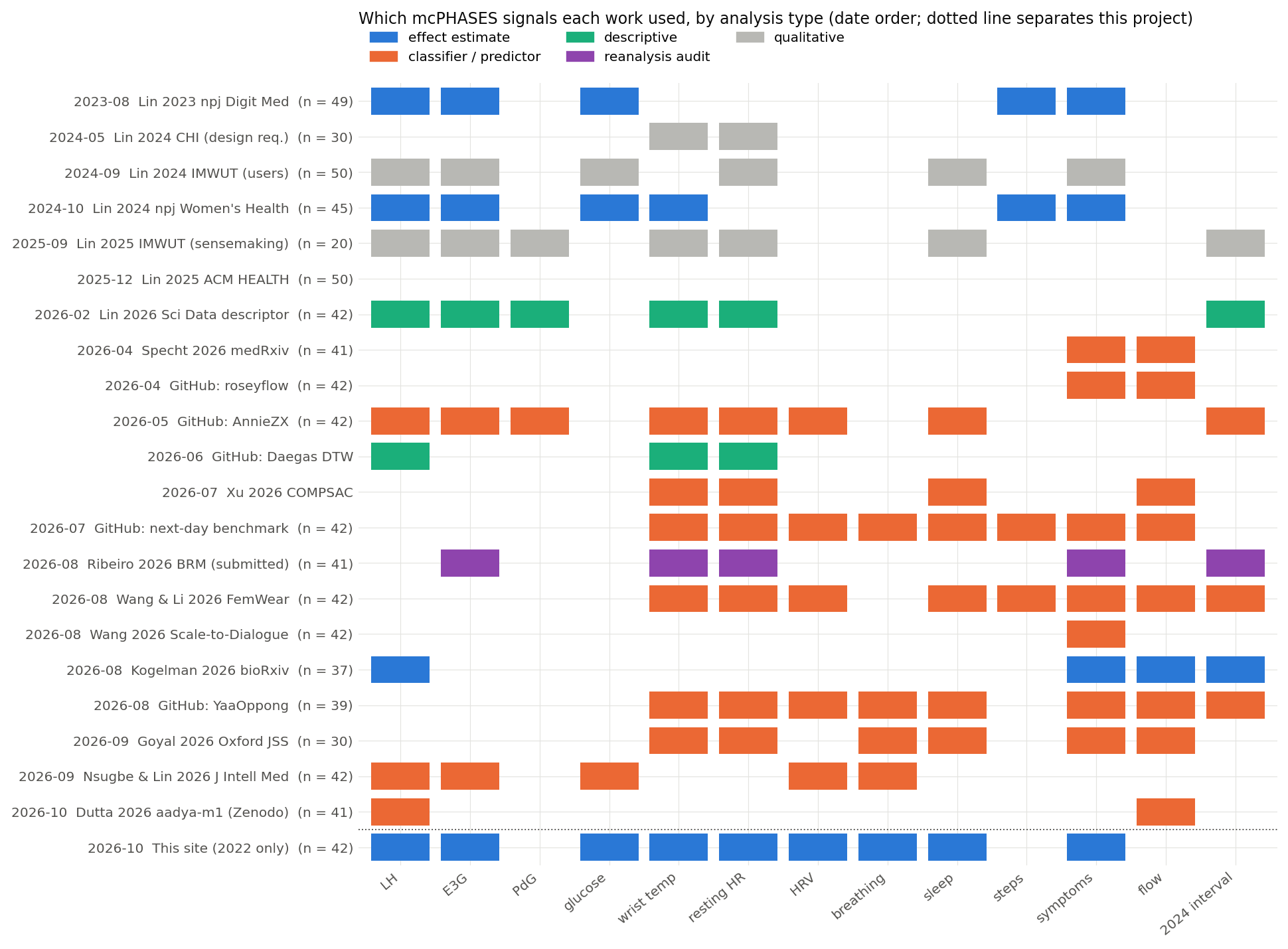
Inventory
| # | Work | Venue, date | Type | n | Headline number |
|---|---|---|---|---|---|
| 1 | Lin et al. 2023 | npj Digit Med, 2023-08 | effect estimate | 49, 149 cycles | Glucose luteal − late-follicular β = 0.15 [0.09, 0.20] mmol/L |
| 2 | Lin et al. 2024 | npj Women’s Health, 2024-10 | effect estimate | 45, 123 cycles | Wrist temperature 34.0 ± 1.0 luteal vs 33.7 ± 0.8 late-follicular; peak 7.6 ± 4.8 d after the LH peak |
| 3 | Lin et al. 2024, CHI | CHI, 2024-05 | qualitative | 30 | Five design requirements |
| 4 | Lin et al. 2024, IMWUT | IMWUT 8(3), 2024-09 | qualitative | 50 | How participants made sense of multimodal tracking |
| 5 | Lin et al. 2025, IMWUT | IMWUT 9(3), 2025-09 | qualitative | 20 | The 2024 return interval as an app study |
| 6 | Lin et al. 2025, ACM HEALTH | ACM Trans Comput Healthc, 2025-12 | qualitative | 50 | Barriers to a holistic view |
| 7 | Lin 2025, PhD thesis | U Toronto, 2025-10 | qualitative | — | Chapters 3–6 are works 4, 3, 5, 6 |
| 8 | Lin et al. 2026, descriptor · PhysioNet | Sci Data, 2026-02 | descriptive | 42 (+20) | Repeated-measures ANOVA across phases: temperature F(3, 123) = 11.63, RHR F(3, 123) = 10.26 |
| 9 | Specht et al. 2026 | medRxiv, 2026-04 | classifier | 41 | Symptoms only, four-phase leave-one-subject-out: 67.6 %, macro-F1 0.662; calendar-only 63.0 % |
| 10 | Xu et al. 2026 | IEEE COMPSAC, 2026-07 | predictor | — | Wearable model beats calendar baselines for next-menses timing; no numbers in the abstract |
| 11 | Wang & Li 2026, FemWear | arXiv, 2026-08 | classifier | 42 | Nested leave-one-participant-out phase macro-F1 0.2955 vs 0.2988 baseline |
| 12 | Wang 2026, Scale-to-Dialogue | arXiv, 2026-08 | classifier | 42 | Six-item vs three-cluster symptom questioning: QWK 0.976 vs 0.913 |
| 13 | Kogelman et al. 2026 | bioRxiv, 2026-08 | effect estimate | 37, 96 cycles | Between-person ICC: cycle length 0.26, late-follicular 0.51, luteal 0.25, menstrual 0.31 |
| 14 | Ribeiro 2026 | Behav Res Methods, submitted 2026-09 | reanalysis audit | 41 | Heterogeneity of E3G coupling not above a phase-randomised null: RHR p = 0.156, temperature p = 0.874; an earlier p = 0.024 was a join artefact |
| 15 | Goyal 2026 | Oxford J Student Scholarship, 2026-09 | classifier | 30 | Bleeding-day ROC-AUC from cycle history alone 0.822; symptoms and wearables did not add |
| 16 | Nsugbe & Lin 2026 | J Intell Med, 2026-09 | classifier | 42, 126 cycles | Multimodal − best unimodal: median +0.0156 macro-F1 |
| 17 | Dutta 2026, aadya-m1 | Zenodo, 2026-10 | forecaster | 41 | An optional LH-test input narrows the 80 % next-period window from ≈ 12 to ≈ 7 days |
Grey literature (repository READMEs, not reproduced): leave-one-subject-out four-phase classifiers in which cycle day carries most of the signal (macro-F1 0.643 from cycle day vs 0.363 from physiology); a 2022 → 2024 distribution shift (KS = 0.322); an LH-aligned clustering of physiology that found no consistent clusters.
What is established, metric by metric
| Metric | Published finding | Source | Not published |
|---|---|---|---|
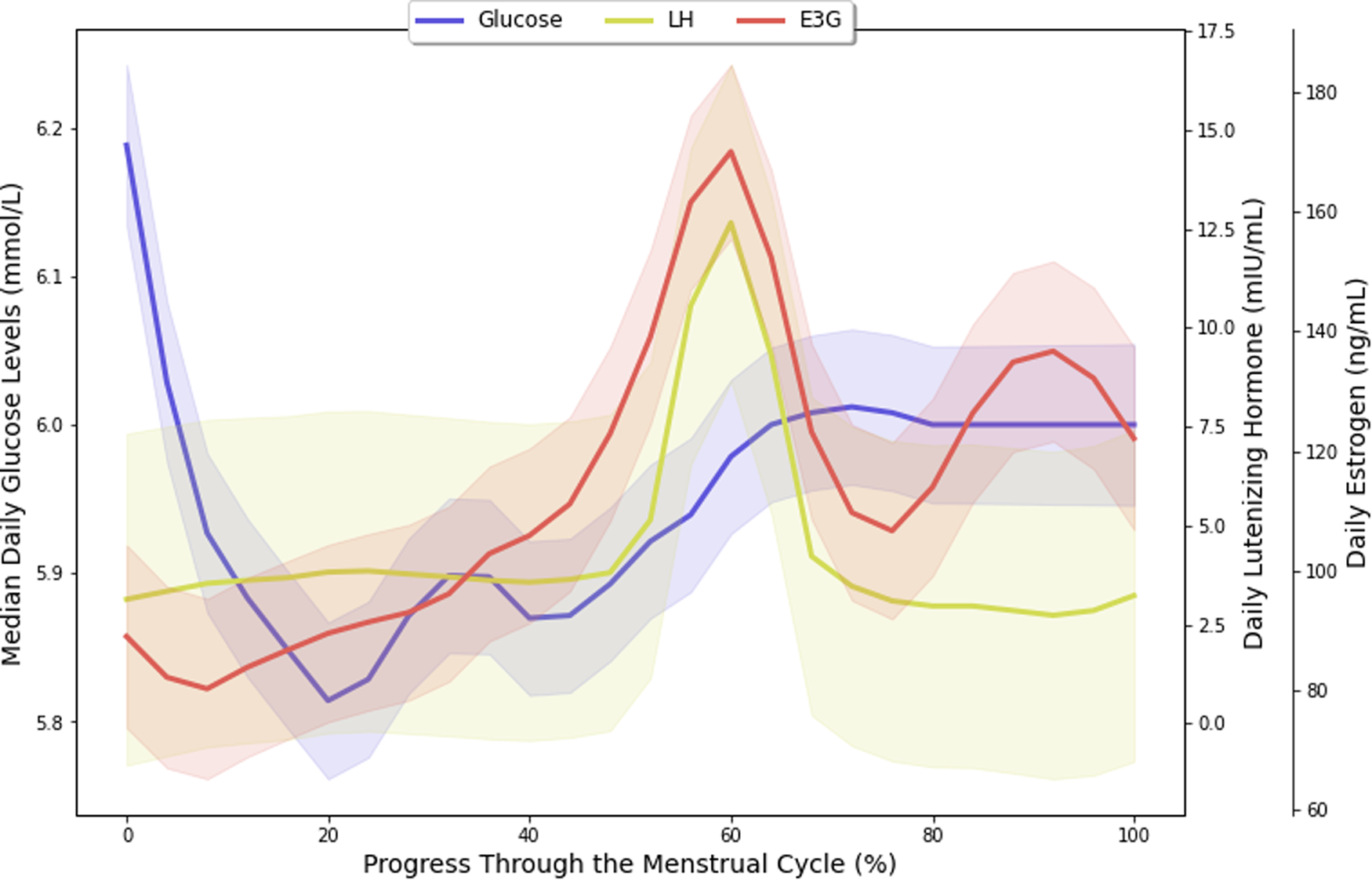
| Glucose | Biphasic over the cycle; luteal − late-follicular β = 0.15 [0.09, 0.20] mmol/L | 1 | Per-person size; repeatability |
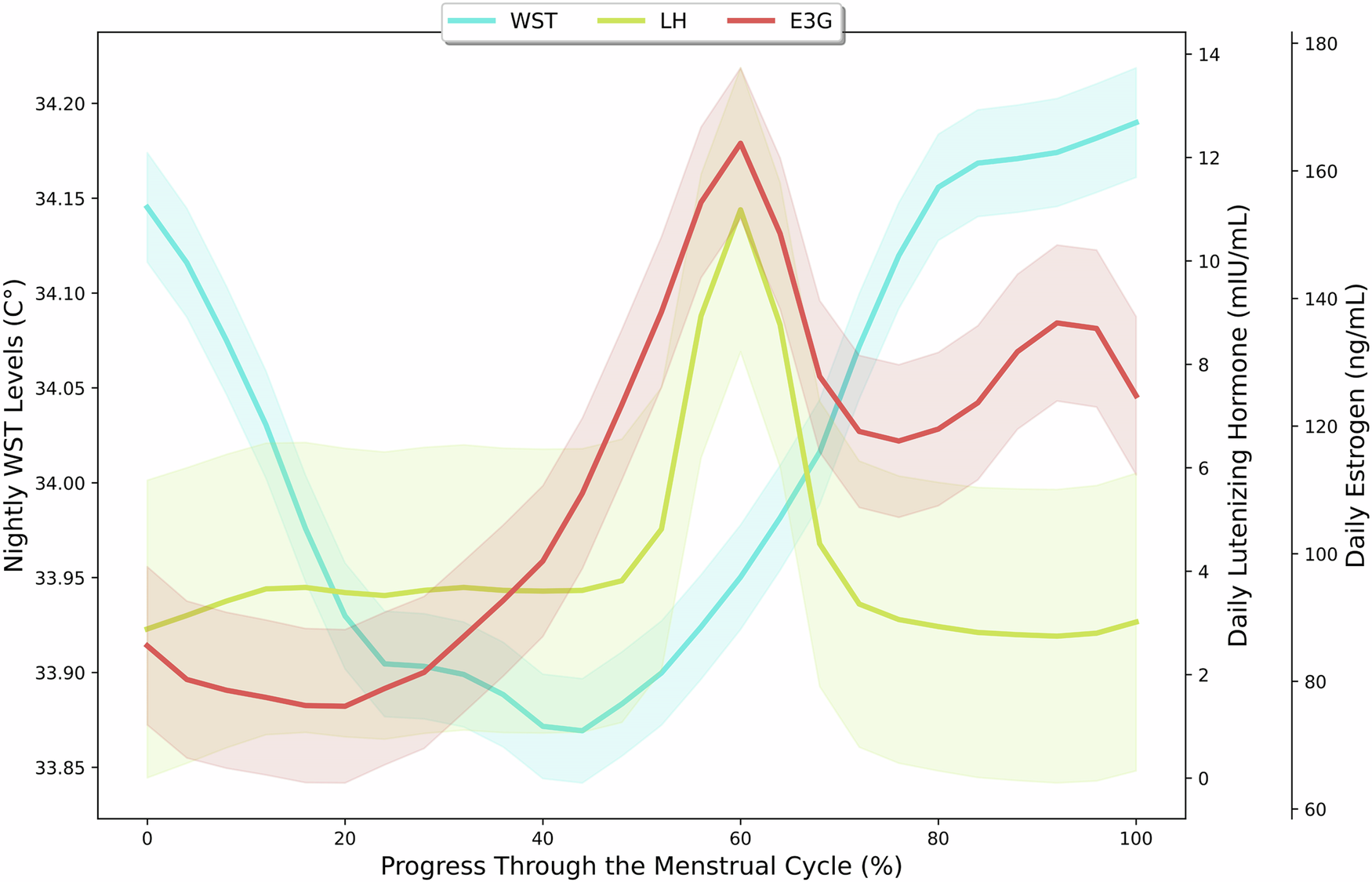
| Wrist temperature | Group means by phase 33.9 / 33.7 / 33.8 / 34.0 °C; peak 7.6 ± 4.8 d after the LH peak | 2, 8 | Effect in °C with an interval; per-person shift |
| Resting heart rate | ANOVA across phases; lowest in follicular, highest in luteal (boxplots only) | 8 | Any size in bpm |
| HRV, breathing rate, sleep | Classifier features only | 11, 16 | Any phase estimate |
| Phase lengths | Median cycle 31 d; menstrual 6, late-follicular 11, luteal 14; ICCs 0.26 / 0.31 / 0.51 / 0.25 | 13 | — |
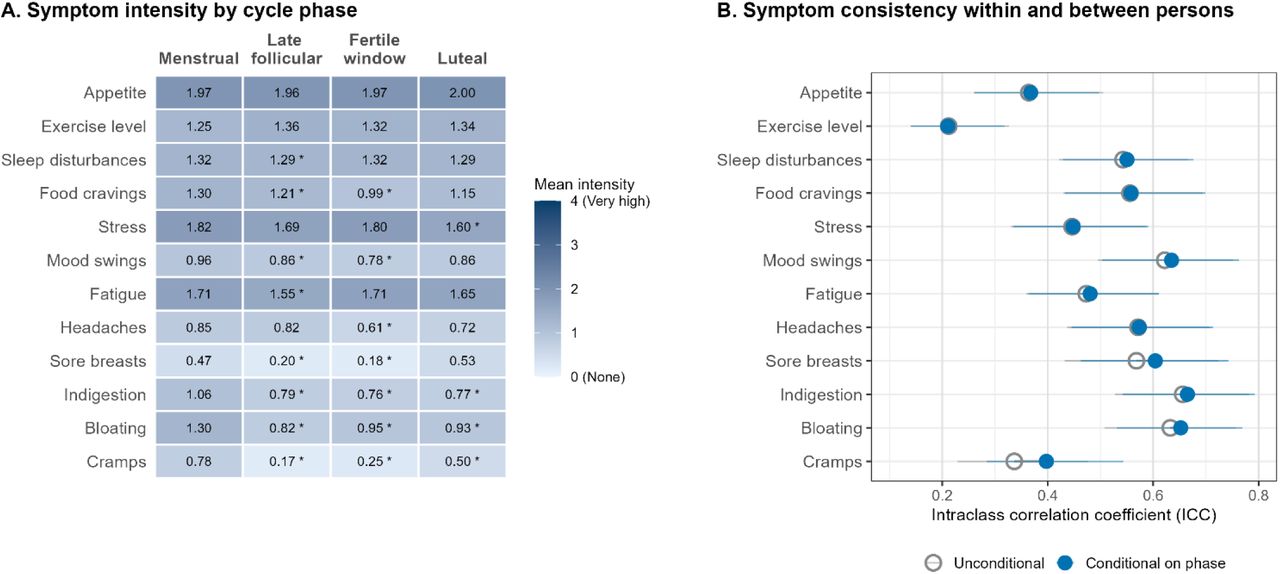
| Symptoms | Luteal vs late-follicular on a probit scale: cramps +0.94, sore breasts +0.97, bloating +0.38; symptom ICCs 0.21–0.66 | 1, 13, 9 | — |
| Heterogeneity | Between-person spread of E3G-coupling slopes not larger than a phase-randomised null | 14 | — |
| 2022 → 2024 | Feature distributions shift; physiology-only phase accuracy falls | grey | Any confirmatory use of 2024 |
Published figures worth knowing
Published results beside the estimates here
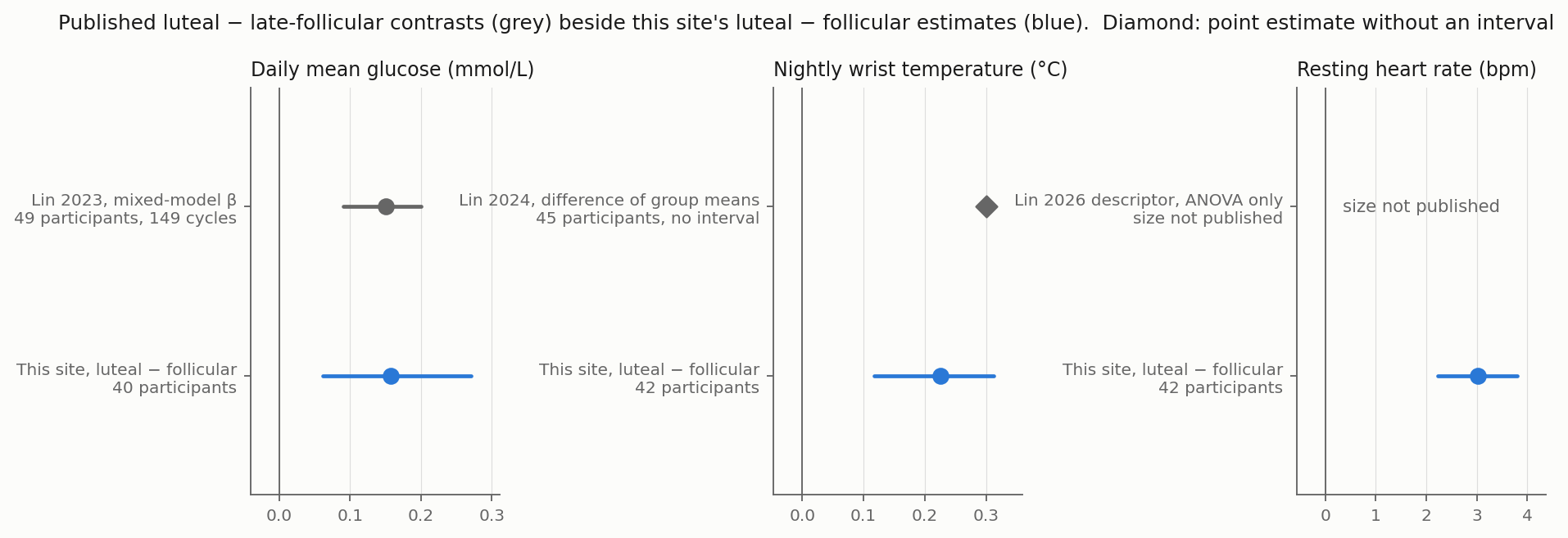
| Metric, luteal − follicular | Published | This site | Agreement |
|---|---|---|---|
| Glucose | β 0.15 [0.09, 0.20] mmol/L, 49 participants | +0.16 [0.06, 0.27], 40 | Same direction and size |
| Wrist temperature | 34.0 vs 33.7 °C, no interval, 45 | +0.23 [0.12, 0.31] °C, 42 | Same direction and size |
| Resting heart rate | F(3, 123) = 10.26, no bpm | +3.0 [2.2, 3.8] bpm, 42 | Direction agrees; size unpublished |
| Breathing rate, HRV | classifier features only | +0.48 /min; −3.9 ms | No published estimate |
| Heterogeneity | E3G-coupling spread not above null | personal shift vector not detectable over 2–3 cycles | Both say person differences are hard to see with few cycles |
Data hazards reported by prior users
| Hazard | Who reports it | Handling here |
|---|---|---|
| Several Fitbit rows per participant-day; a naive join multiplies observations | Ribeiro audit (p 0.024 → 0.874) | One value per participant-day before any join |
| Resting heart rate 0 means missing; undocumented | Ribeiro; this project | 0 treated as missing |
| Glucose in mg/dL for two participants | GitHub issue on the dataset repository; this project | Converted on the participant’s median |
| 2022 and 2024 differ: no diary, PdG added, different RHR export, distribution shift | Descriptor Fig. 2; repositories; Kogelman | 2024 held out |
| Published cohort results use 45–49 participants; 42 released | Dataset authors | Same-direction checks only |
| Symptom diary collected while participants saw their phase predictions | Lin 2024 IMWUT | Symptom contrasts are not blind |
| Phase lengths depend on the labeller | Works 1, 8, 13 | Reference phase stated on every page |
Licences of the material reproduced here
| Source | Licence | Use on this site |
|---|---|---|
| Lin 2023 | CC BY 4.0 | Figure reproduced with attribution |
| Lin 2024, Lin 2026 descriptor | CC BY-NC-ND 4.0 | One figure reproduced without change, non-commercial |
| Kogelman 2026 | CC BY | Figure reproduced with attribution |
| Specht 2026 | CC BY | Numbers only |
| arXiv works | CC BY 4.0 | Numbers only |
| Nsugbe & Lin 2026 | CC BY 4.0 (full text not accessible) | Numbers from the abstract only |
| Goyal 2026, Xu 2026 | not stated or inaccessible | Numbers from the abstract only |